
Still in the Game: NFHCA Coaches On World Stage
There is a familiar rhythm to August for field hockey coaches.
Preseason schedules. Team meetings. Practice plans. The anticipation of another season.
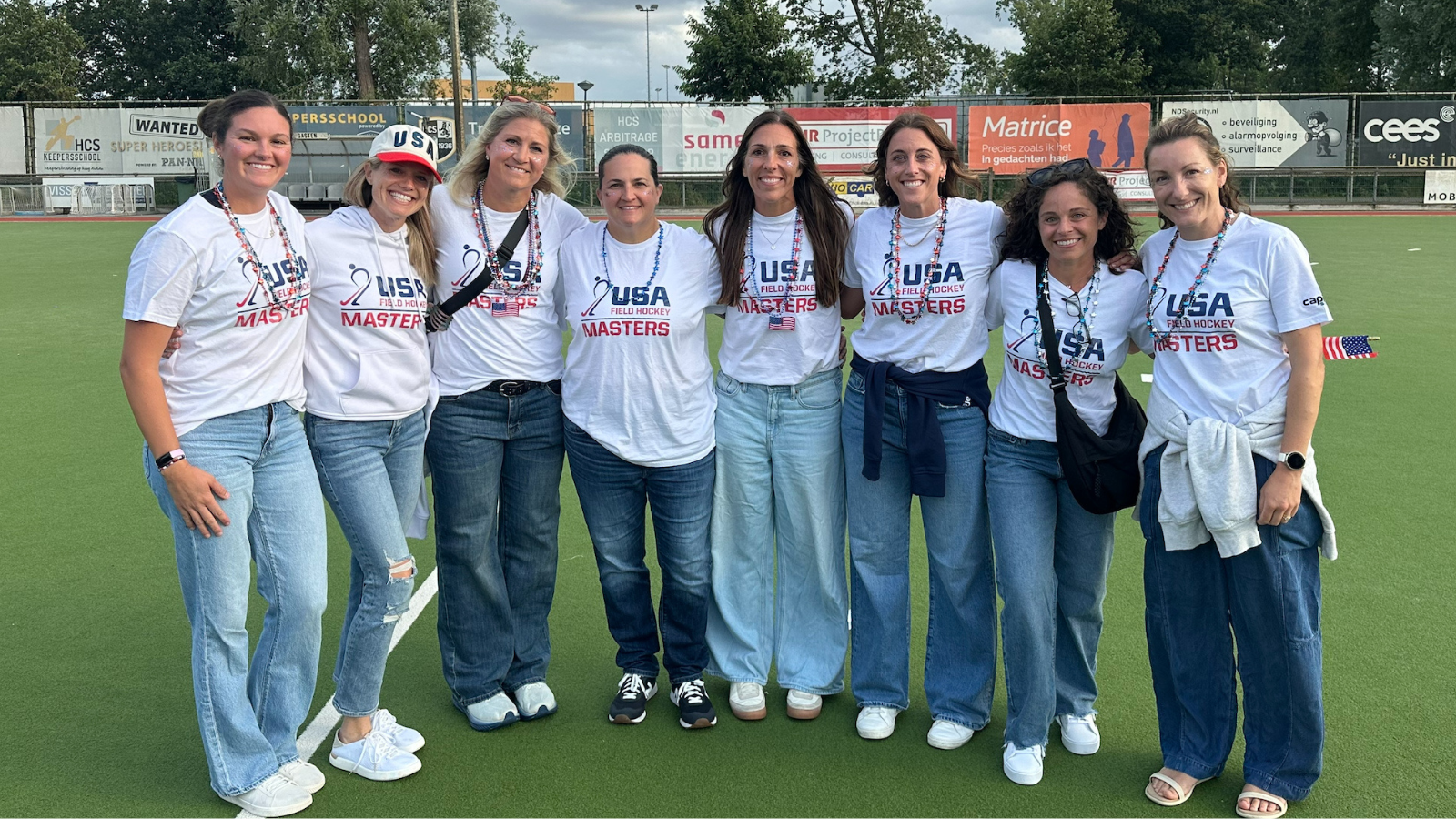
But this summer, before many NFHCA coaches return to their own sidelines, they found themselves on another one — or stepped back onto the field themselves — wearing USA across their chests at the 2026 World Masters Hockey World Cup.
Across four cities in Belgium and the Netherlands, more than 400 teams are competing in the World Masters Hockey (WMH) World Cup from July 22 through August 16. The United States sent 15 teams across men’s and women’s divisions from O-35 through O-65.
Among them are a number of coaches who spend most of the year giving to the game.
This summer, they got to keep playing it.
The Game Keeps Giving Something Back
For NFHCA Hall of Famer and former college coach Anne Parmenter, who played for the U.S. Women’s O-60 team, Masters hockey has opened a door to a version of the sport that feels both new and wonderfully familiar.
“This is our world! We get to travel to places around the world we’d never go to if it wasn’t for hockey. We experience the people and the cultures from far off places. We are coached and treated like world class athletes who still get butterflies as we put our game uniforms on. We watch game film and have team strategy zoom calls. We reconnect with former teammates from around the world. And field hockey has been that connection that runs so deeply in all of us. That’s what master World Cup hockey has given to all of us. The masters community continues to grow.”
The butterflies may be the best part.
For people who have spent decades in the sport, there is still a game to prepare for, a uniform to pull on, a teammate to find with a pass and another opportunity to compete.
Legendary NFHCA Hall of Famer and retired high school coach Linda Kreiser knows that feeling well. After a playing career that included high school, college, the U.S. National Team and years with the Red Rose Field Hockey Club, Kreiser competed with the U.S. Women’s O-65 team.
“I played field hockey in high school, college, on the USA Team and for years with my Red Rose Club Team. In 2016, I had the opportunity to renew my playing career on the USA Masters team. I have been blessed to represent my country, play with amazing teammates, be coached again and participate in the growth of Masters. It is wonderful to compete against players from around the world who share the love of the game.”
That idea of being coached again is easy to overlook.
Coaches spend so much of their lives providing the feedback, setting the standard and helping someone else improve. Masters competition reverses those roles. They become the athlete again. They get pushed. They get nervous. They learn.
And sometimes they have to find out just how much they still have in them.
Widener University head coach Melissa McCarthy competed on the U.S. Women’s O-35 team only four weeks after wrist surgery, while also completing her second Masters World Cup of 2026 after representing the United States indoors earlier this year.
“Staying in the game of field hockey in every capacity possible will always be core to who I am. Representing Team USA at two consecutive Masters World Cups this year (Indoor & Outdoor) was a powerful reminder that we can always do hard things, learn something new every day, and enjoy the journey and friendships along the way. Competing in Outdoor just four weeks post-wrist surgery was a unique challenge, but I hope it serves as an example to athletes at any age that mindset and determination are just as crucial to success as physical preparation.”
The Coach Stays the Example
The Masters World Cup is not simply a collection of former players unwilling to hang up their sticks. It is a highly competitive international event, and its athletes make a considerable commitment to get there.
Masters athletes are self-funded and also help support the expenses of their coaching and medical staffs. They travel to training sessions, prepare independently and fit an international playing schedule around careers and families.
West Chester University assistant coach Kelsi Lykens saw that commitment from a different vantage point as an assistant coach with the U.S. Women’s O-35 team.
“Coaching the Women’s O-35 team at the Master’s World Cup was a new and special experience for me. Watching these women make the time to do something for themselves by traveling to trainings, preparing on their own, and competing at a high level, all while continuing to do something they love, was empowering. Many of them are moms, and knowing their kids were watching them from the sidelines or cheering them on from home through the livestream allowed them to have an even greater impact and inspire the next generation. It was a great reminder that field hockey can be part of your life for as long as you want it to be, and there is always a reason to stay in the game.”
That may be one of the most important images to come out of the tournament: children watching their parents compete for their country.
The lesson does not require a speech.
They can see it.
A Different Side of the Sideline
For Quinnipiac University head coach Nina Klein, the World Cup offered another kind of return to international hockey.
Klein, who once wore the USA jersey as a player, served as head coach of the first U.S. Women’s O-35 International Masters Cup team. Her team earned a silver medal, but the result was only part of what she took home.
“I had an incredible experience coaching the first-ever IMC O35 USA World Cup team. The silver medal was certainly special, but being part of something new, learning from such great people, and continuing to grow as a coach was the real reward. Having once worn the USA jersey myself, it was especially meaningful to experience this tournament from the other side of the sideline. The U.S. Masters program is a tremendous community, and after one cycle of coaching, I’m already hooked. Grateful for the experience, the people, and the opportunity to keep giving back to the game.”
One of the players Klein coached was Barton College head coach Colleen Cassada.
For Cassada, playing and coaching are not competing identities. Each informs the other.
“The Masters World Cup has reinforced why I love this sport. Field hockey isn’t just something I coach—it’s part of who I am. Being able to compete internationally while leading a college program allows me to bring fresh experiences, perspective, and passion back to my student-athletes every day. Staying in the game allows us to continue building relationships, chasing new goals, giving back to the sport that has given us so much, and showing the next generation that field hockey can truly be a lifelong passion.”
Lander University head coach Robbert Schenk experienced that same connection when he returned to World Cup competition with the U.S. Men’s O-35 team.
“Returning to the World Cup after years away was an unforgettable experience. Competing on the world stage reminded me why I love field hockey. I made friendships that will last well beyond the tournament. Most importantly, as a coach, I hope I showed my student-athletes to keep chasing opportunities and leading by example.”
For coaches, perhaps that is one of the unexpected gifts of continuing to play.
Their athletes get to watch them do the very things they ask of their teams every day: prepare when nobody is watching, accept coaching, handle nerves, compete under pressure, be a good teammate, respond to setbacks and keep pursuing something that matters to them.
Coaches Are Everywhere at this World Cup
Parmenter, Kreiser, McCarthy, Lykens, Klein, Cassada and Schenk represent only part of the NFHCA community participating in this summer’s World Cup.
NFHCA Board member and Division III representative Janelle Benner, Field Hockey Club of Connecticut owner and Staples High School head coach Ian Tapsall, Bates College assistant coach Ian Wagge, Penn State Harrisburg head coach AJ Misselhorn, Broad Run High School and Hammers Field Hockey coach Meg Dudek, former Yale head coach Pam Stuper, Performance Sports Events (PSE) owner and former college coach Ainslee Lamb, Stevenson University assistant coach Jen Anderson, and Villanova associate head coach Karlie Kisha are among the many other coaches involved in the competition. They represent just a snapshot of the NFHCA members participating as players and coaches, with many others across the association also taking part in this year’s Masters competition.
Some are playing. Some are coaching. Some have been in the sport for decades. Others are experiencing Masters competition for the first time.
Their presence says something important about what a life in field hockey can look like.
There does not have to be a final season.
The relationship with the sport can change. Player can become coach. Coach can become player again. Former teammates can reunite years later in another country. A coach who spends most of the year helping young athletes chase their goals can discover that there are still goals worth chasing, too.
And maybe that is the real Stay in the Game story coming out of Belgium and the Netherlands this summer.
It isn’t simply that NFHCA coaches are still playing field hockey.
It’s that field hockey is still giving them something: competition and connection, new friendships and old ones, another chance to learn, another reason to travel, another challenge to take on and, yes, even butterflies before a game.
The 2026 World Masters Hockey World Cup ends Sunday, August 16. For these coaches, it’s just one more reminder that there doesn’t have to be a final season.

AstroTurf® is the Official Sponsor of the 2027 NFHCA Annual Convention and The Scoop newsletter. With more than 50 years of experience and millions and millions of square feet of synthetic turf in use worldwide, AstroTurf® products bring more technological expertise and real-world know-how to the game than any other brand.